The Greater Palm Springs real estate market entered its traditional summer low season in July 2026, bringing fewer transactions and less overall market activity across the Coachella Valley. But beneath the seasonal slowdown, several important indicators remained surprisingly resilient.
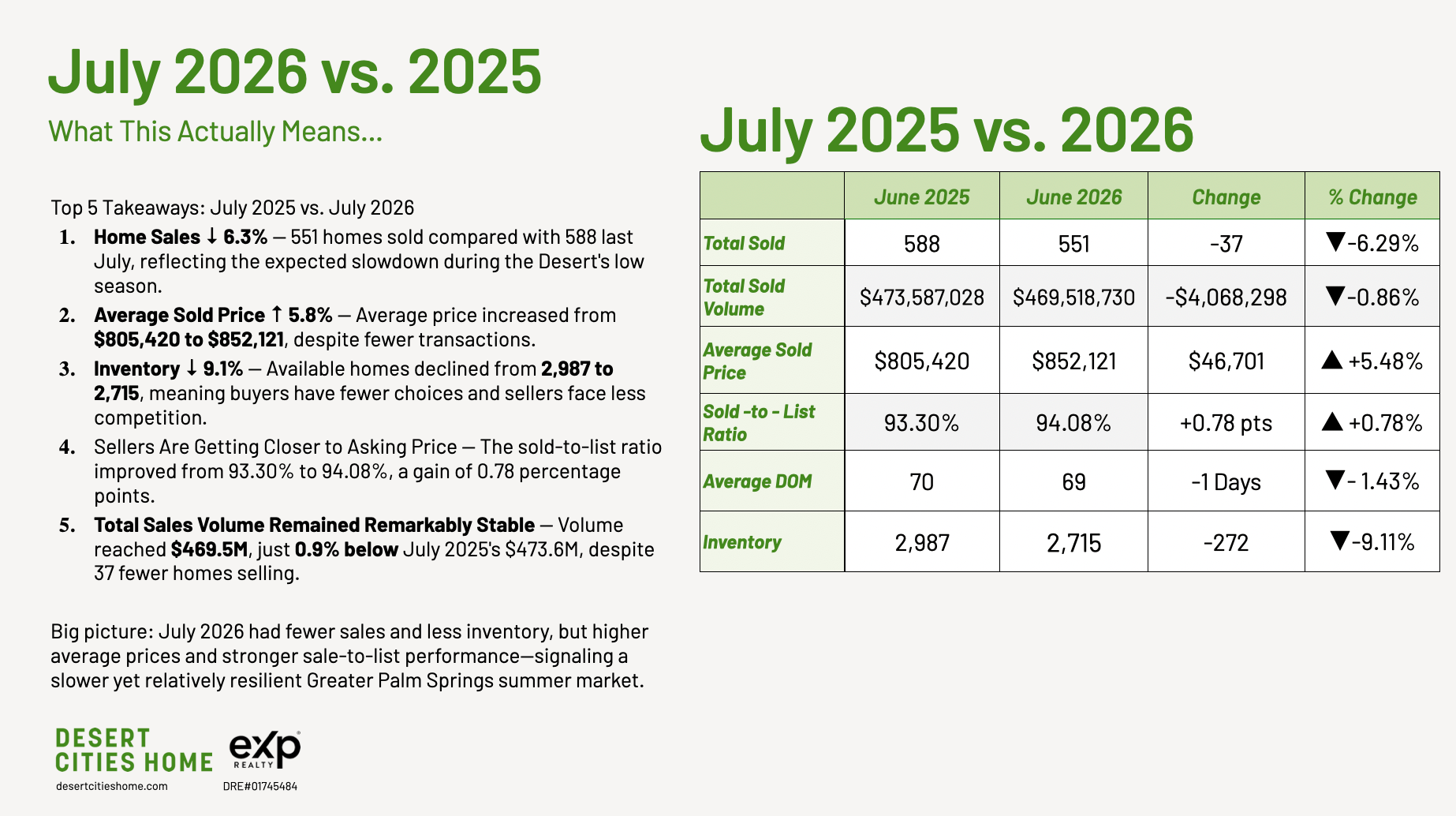
Closed sales declined 6.3% year over year, while the number of homes for sale fell even more sharply, dropping 9.1%. At the same time, the average sale price increased 5.8% to $852,121, sellers received a slightly higher percentage of their asking prices, and total sales volume remained nearly unchanged at approximately $469.5 million.
The takeaway? Greater Palm Springs is experiencing a slower and more selective summer market — not a collapsing one.
For buyers, August may provide opportunities to negotiate with motivated sellers during the low season. For sellers, reduced inventory means less competition, but pricing, presentation, condition, and marketing will be critical to capturing the attention of the smaller summer buyer pool.
July 2026 Greater Palm Springs Real Estate Market Overview
July is traditionally one of the slowest months for real estate in Greater Palm Springs and the Coachella Valley.
As desert temperatures rise and many seasonal residents leave for the summer, buyer traffic typically decreases. Homeowners who don't need to sell immediately may also choose to wait until fall or winter to list their properties.
That seasonal pattern was evident in July 2026.
Across the Desert Cities, there were 551 closed residential sales, compared with 588 sales in July 2025. That's a year-over-year decline of approximately 6.3%.
But transaction count only tells part of the story.
Despite 37 fewer sales, total dollar volume declined by only about 0.9%, finishing July at approximately $469.5 million.
In other words, fewer homes sold, but the properties that did sell tended to transact at higher price points.
That distinction is important when evaluating the overall health of the Greater Palm Springs housing market.
Average Sale Price Climbed to $852,121
The average sold price across the Desert Cities reached $852,121 in July 2026, approximately 5.8% higher than the $805,420 average recorded in July 2025.
That's notable considering overall transaction activity declined.
The luxury segment appears to have contributed meaningfully to the increase.
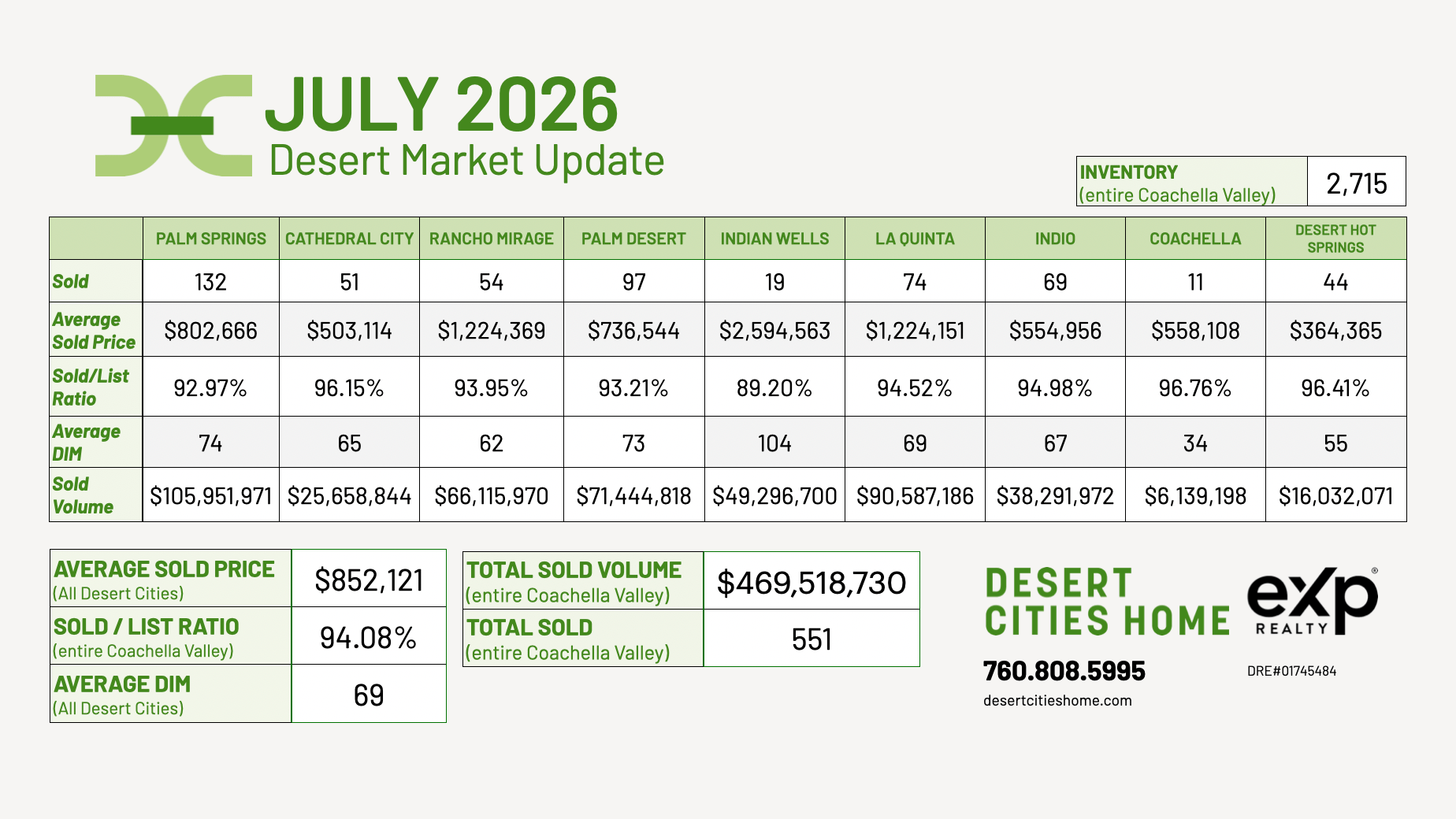
Indian Wells recorded an average sale price of approximately $2.59 million, while Rancho Mirage and La Quinta both averaged roughly $1.22 million.
Palm Springs remained substantial at approximately $803,000.
It's important, however, not to interpret a rising average sale price as a direct measure of home-value appreciation.
Average prices can shift depending on the composition of properties sold during a particular month. If more luxury homes close during one period, for example, they can pull the overall average higher even if individual properties throughout the market aren't appreciating at the same rate.
For homeowners trying to determine what their Greater Palm Springs home is worth, citywide averages should therefore be viewed as a market indicator rather than a substitute for a property-specific valuation.
Sellers Are Getting Slightly Closer to Asking Price
Another encouraging July indicator was the 94.08% average sold-to-list price ratio, up from 93.30% in July 2025.
That's an improvement of 0.78 percentage points year over year.
A roughly 94% ratio still indicates buyers have negotiating leverage in many situations. But the improvement suggests appropriately positioned properties are holding their ground somewhat better than they were last summer.
The differences between individual Desert Cities are particularly revealing.
Coachella recorded a 96.76% sold-to-list ratio, followed by Desert Hot Springs at 96.41% and Cathedral City at 96.15%.
At the opposite end of the spectrum, Indian Wells recorded 89.20%.
This reinforces one of the most important realities of today's Coachella Valley housing market:
There isn't one single Greater Palm Springs real estate market.
Conditions can change substantially based on the city, neighborhood, country club or community, price range, property condition, location, days on market, and seller motivation.
A $600,000 home in Cathedral City can face an entirely different supply-and-demand environment than a $2.5 million luxury property in Indian Wells.
For buyers and sellers, understanding that micro-market is becoming increasingly important.
Greater Palm Springs Housing Inventory Fell 9.1%
One of the most important statistics in the July 2026 market report is inventory.
There were 2,715 homes for sale, compared with 2,987 in July 2025.
That's a 9.1% year-over-year decline in available inventory.
Why does this matter?
Looking only at the 6.3% decline in closed sales could create the impression that demand is weakening considerably.
But inventory declined even more than sales.
That's very different from a housing market where buyer demand is falling while available inventory rapidly accumulates.
Instead, the July numbers suggest we're seeing the traditional summer retreat on both sides of the Greater Palm Springs housing market.
There are fewer buyers actively shopping during low season — but there are also fewer sellers competing for those buyers.
For homeowners considering selling, that can create an important opportunity.
The summer buyer pool may be smaller, but a well-positioned property also has fewer competing listings fighting for that buyer's attention.
Days on Market Remains Elevated but Stable
Homes averaged approximately 69 days on market in July 2026, compared with 70 days in July 2025.
Essentially, there was very little year-over-year change.
This tells us buyers are generally taking their time.
Homes aren't necessarily selling immediately, and sellers should prepare for a longer marketing period than they may remember from the exceptionally fast-moving pandemic-era housing market.
But context matters.
Stable days on market combined with lower inventory, higher average sale prices, and an improved sold-to-list ratiodoes not suggest broad deterioration.
Instead, the numbers point toward a market that is slower, more balanced, and considerably more selective.
Buyers are willing to act when the right property comes along — but they're also less willing to overlook condition, location, or an unrealistic asking price.
A Closer Look at the Individual Desert Cities
The 551 homes sold throughout Greater Palm Springs in July 2026 were distributed very differently across the Coachella Valley.
Palm Springs led the region with 132 closed sales, followed by Palm Desert with 97 and La Quinta with 74.
Luxury markets continued to have an outsized influence on overall dollar volume.
Rancho Mirage generated approximately $66.1 million in sales from only 54 transactions, while Indian Wells produced nearly $49.3 million from just 19 sales.
Palm Springs led the Desert Cities in overall sales volume at approximately $106 million, followed by La Quinta at $90.6 million and Palm Desert at $71.4 million.
Price point also appears to be affecting negotiating dynamics and marketing times.
For example, Coachella averaged just 34 days on market, while Indian Wells averaged 104 days.
This is another illustration of how segmented the Greater Palm Springs real estate market has become.
Higher-end buyers generally have more options and the financial flexibility to remain patient, particularly when purchasing a second home or luxury residence. That can give them additional negotiating leverage.
At more accessible price points, however, a properly priced property can still attract strong buyer interest and sell relatively close to its asking price.
What Greater Palm Springs Home Buyers Can Expect in August 2026
August keeps us firmly within the Greater Palm Springs summer low season, which typically continues through the end of September.
For buyers, this can be one of the more strategically interesting times of the year to purchase a home in the Coachella Valley.
There are fewer listings than there were last summer, so buyers shouldn't assume they'll have unlimited choices.
However, sellers who remain actively listed through the hottest months of the year may have stronger motivation to negotiate.
This is particularly worth exploring with properties that have accumulated 60, 90, or more than 100 days on market.
Depending on the property and seller's circumstances, buyers may have opportunities to negotiate not only the purchase price but also other terms, such as:
- Seller closing-cost credits
- Repair credits
- Mortgage rate-buydown assistance
- Furniture or furnishings
- Home warranty coverage
- Flexible possession or closing dates
- Other property-specific concessions
With the overall July market closing at approximately 94% of asking price, buyers should not automatically assume that the list price is the final price.
At the same time, every property needs to be evaluated individually.
A newly listed, beautifully updated home in a desirable community that is priced appropriately can have a very different negotiating environment from an overpriced property that has been sitting on the market since spring.
Low season can create opportunities, but the best strategy depends on the individual property.
What Greater Palm Springs Home Sellers Can Expect in August 2026
Sellers face a different strategic environment.
August generally isn't the ideal time to test the market with an aspirational asking price.
There are fewer buyers actively touring homes during the summer, and the buyers who are shopping tend to have access to substantial market information. They can quickly recognize when a property is priced significantly above comparable sales or competing listings.
But sellers have an important advantage heading into August:
Lower inventory.
With approximately 2,715 homes available compared with nearly 3,000 last July, homeowners entering the market aren't facing as much competition as they did a year ago.
That means a property that is properly priced, beautifully presented, and aggressively marketed can still stand out during low season.
For August sellers, the initial market launch is especially important.
Professional photography, high-quality video, digital marketing, online exposure, property condition, staging, and pricing against the most relevant recent comparable sales can all influence whether a home captures attention.
The goal isn't simply to put another house on the market.
It's to become one of the homes that the smaller summer buyer pool actually wants to see.
The Bigger Picture: A Resilient Greater Palm Springs Low Season
July 2026 looks more resilient than the decline in transaction count might initially suggest.
Sales declined 6.3%, but inventory fell 9.1%. Average sale price increased 5.8%, the sold-to-list ratio improved, and total dollar volume was virtually unchanged at just under $470 million.
Those are not the characteristics we would typically associate with widespread market distress.
Instead, they're more consistent with a seasonally slower and increasingly selective Greater Palm Springs housing market, where pricing, location, property quality, and seller motivation are playing a larger role in determining individual outcomes.
As we move through August and September, three statistics will be particularly important to watch:
Inventory, days on market, and the sold-to-list price ratio.
If inventory continues to contract while days on market and negotiating ratios remain relatively stable, the Coachella Valley could enter an interesting position as summer ends and seasonal residents and buyers begin returning to the desert.
For buyers, low season may provide negotiating opportunities that become more difficult to find once seasonal demand returns.
For sellers, reduced competition can be an advantage — but only when the property is positioned correctly from day one.
What This Means Across the Desert Cities
Real estate throughout Greater Palm Springs is highly localized, which is why valley-wide statistics should always be considered alongside conditions within an individual city, neighborhood, country club, or community.
At Desert Cities Home, we track real estate trends throughout Palm Springs, Rancho Mirage, Palm Desert, Indian Wells, La Quinta, Cathedral City, Indio, Desert Hot Springs, and the surrounding Coachella Valley communities.
A luxury estate in Indian Wells, a golf-course home in Rancho Mirage, a 55+ community property in Palm Desert, and a mid-century home in Palm Springs may all be located within the same regional housing market — but they can have dramatically different buyer pools, inventory levels, pricing trends, and negotiating dynamics.
That's particularly important during the summer low season.
For buyers, understanding where negotiating opportunities exist can be just as important as identifying the right home.
For sellers, knowing how your property competes within its specific neighborhood and price range — rather than relying solely on Greater Palm Springs averages — can make the difference between accumulating days on market and securing a successful sale.
Whether you're considering buying a home, selling a property, relocating to Greater Palm Springs, purchasing a second home, or exploring retirement options in the Coachella Valley, local market knowledge matters more as the market becomes increasingly segmented.
Desert Cities Home, brokered by eXp Realty of California, Inc., helps buyers and sellers navigate the individual markets that make up Greater Palm Springs with property-specific pricing, local market analysis, and strategic representation.
Mike Z. Haque
Realtor® | Desert Cities Home brokered by eXp Realty
CalBRE #01745484
760.808.5995