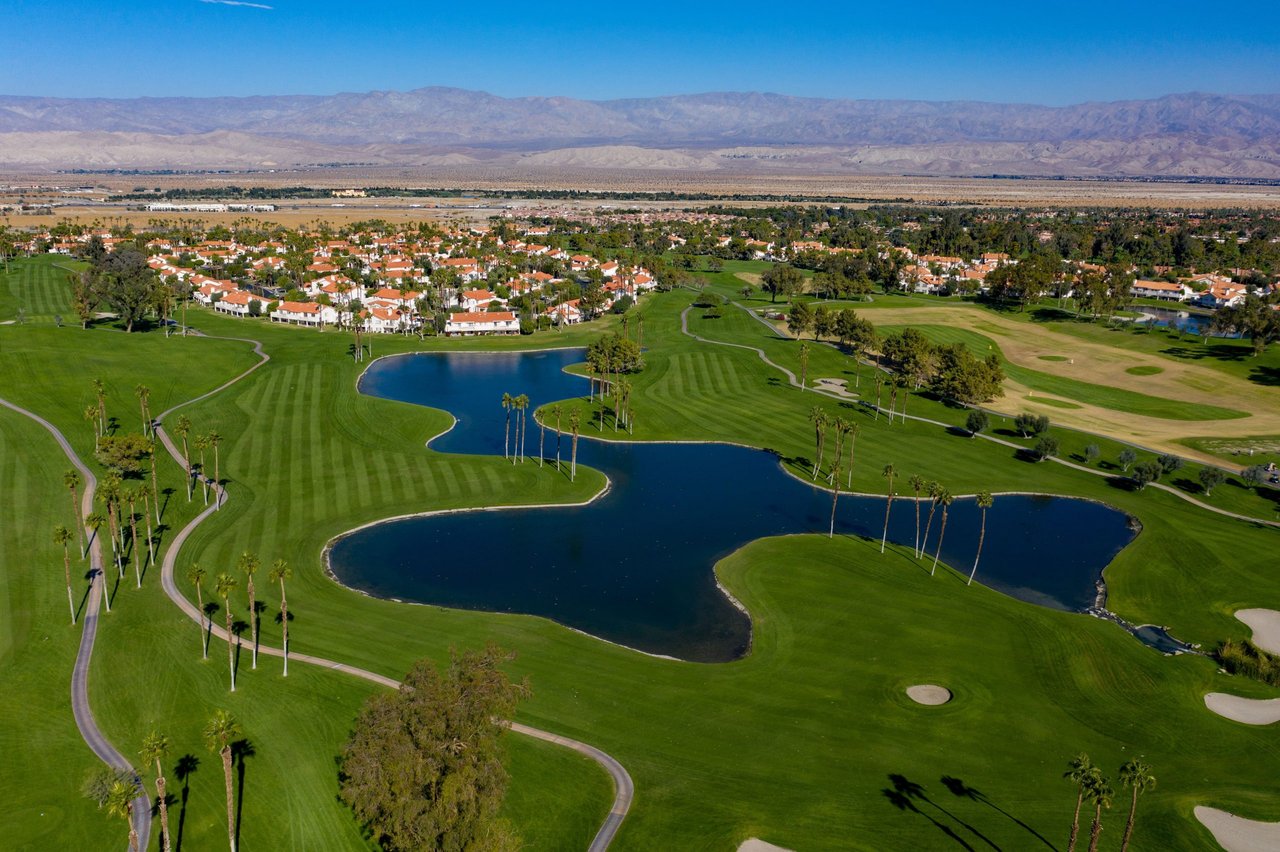
Pull up two comparable condo listings in Desert Falls Country Club and you can find one advertising HOA dues in the $350 to $500 range and another quoting $849 a month, sometimes $871. Neither number is wrong. They describe different corners of the same gated community off Country Club Drive, and if you build your monthly budget around whichever listing you happened to click first, you will be off by a few hundred dollars before you ever pick up a golf club.
That gap is the actual story here. Desert Falls gets marketed as one of the better values among Palm Desert's golf communities, and on paper it is. But "the HOA dues at Desert Falls" is not a single fact you can look up once and carry with you. It is a range that depends on which sub-association your unit belongs to, and separately, on whether you plan to golf at all. Buyers comparing Palm Desert communities on a spreadsheet tend to treat HOA dues like a fixed cost, similar to property tax. At Desert Falls, it behaves more like a menu.
The two prices that don't match
Desert Falls was built out as a mix of condos, townhomes, and single-family attached homes, and the community runs on multiple sub-associations rather than one master HOA billing everyone the same rate. Some listings put attached-home dues in the $350 to $500 range depending on the sub-association and what's included. Others, pulled from MLS-fed data, show a "recent HOA" figure of $849 a month, and a separate listing quotes $871, with that higher number covering cable, earthquake insurance, guarded and roving security, and trash service bundled in. Both figures are accurate. They just describe different units with different inclusions.
Golf runs on its own separate track entirely. Buying a home at Desert Falls does not come with a golf membership attached, which is a different model than the bundled-membership clubs elsewhere in the valley. Membership is purchased directly from the club, and the club also sells seasonal play passes in 12-round and 20-round blocks for residents who want to play occasionally without joining. Here is roughly what that optional layer costs, based on current listing data:
Path | What you're paying for | Approximate cost |
|---|---|---|
No club membership | HOA-covered amenities only: pools, tennis, pickleball, fitness center | Included in HOA dues |
Social/Fitness/Tennis membership | Club dining, social calendar, no golf | ~$500 initiation, roughly $75 to $104 a month depending on the listing |
Full golf membership | Unlimited course access plus social privileges | ~$13,000 initiation, roughly $468 a month (about $5,616 a year) |
Pay-as-you-play golf | Seasonal 12-round or 20-round passes, no membership commitment | Confirm current pricing with the membership office |
The golf initiation fee is the one number that holds steady across sources at around $13,000. The monthly dues are where things get inconsistent again. Two listings put golf dues at roughly $468 a month. A third puts them at $1,530 a month, more than three times higher, without specifying which membership tier that figure reflects. That kind of spread is exactly why a buyer who cares about golf access should get current numbers from the membership office directly rather than from whatever figure happens to appear on a real estate listing.
In Desert Falls, the price on the listing sheet tells you what the unit costs to buy. It does not tell you what it costs to keep.
A community assembled in pieces
The inconsistency does not stop at fees. Sources cannot even agree on when Desert Falls was built or how many homes it contains. Most club and course references place the community's founding in 1984, designed by Ronald Fream, but at least one brokerage page lists 1988 and another lists 1994. Unit counts show similar drift: some sources say 925 homes, others say 1,086, and several settle on approximately 1,100 condos, townhomes, and single-family properties.
None of this is sloppy reporting so much as a byproduct of how the community actually grew. Desert Falls was developed in phases over years, each phase carrying its own sub-association, its own budget, and its own paperwork trail. A community built that way rarely ends up with one tidy master record, and that is precisely why the HOA resale packet for your specific unit matters more here than the general community brochure. The packet tells you what your sub-association actually charges, what it covers, and whether an assessment is already being discussed. The brochure tells you about the 35,000-square-foot clubhouse and the mountain views, both real, neither useful for budgeting.
What this looks like against the 2026 market
Narrow in on Desert Falls itself and the same pattern of numbers not quite agreeing with each other shows up again, this time inside a single data source. Over the three months ending in May 2026, the median sale price for a home in Desert Falls was $540,000, up 2.0 percent from the same period a year earlier. The average sale price for the most recent single month in that data, though, came in at $645,000, up 49.4 percent year over year, a jump large enough to suggest a handful of higher-priced sales pulled the average well away from the median rather than signaling the whole neighborhood repriced overnight.
That $540,000 median also sits well below the broader Palm Desert citywide median of $604,638 over the same three-month window, up 5.2 percent year over year, with the typical Palm Desert home taking about 78 days to sell. Desert Falls is trading at a real discount to the city median it sits inside, consistent with its reputation as one of the better values among Palm Desert's golf communities. That discount is exactly why it matters more here, not less, to know precisely what the price does and does not include before you sign.
The practical read for a buyer comparison-shopping Palm Desert golf communities right now is about leverage more than headline price. Palm Desert overall scores just 20 out of 100 on Redfin's competitiveness scale, and the typical home there receives about one offer, not several. That is not a market where you need to waive contingencies to compete. It is a market with enough breathing room to ask for the full HOA resale packet before you remove them, and to compare your specific sub-association's numbers against the next listing over instead of anchoring to whatever HOA figure happened to catch your eye first.
Before you remove your contingencies
If you're seriously comparing units at Desert Falls, a few requests up front save you from an unpleasant surprise later.
- Ask for the HOA resale packet tied to the specific sub-association for that unit, not a general community summary. You want the CC&Rs, the current budget, the most recent reserve study, the insurance summary, and board minutes from the past twelve months.
- Get written confirmation of any pending or planned special assessments. A quiet board discussion about roof work or repaving can turn into a bill a few months after you close.
- Ask whether the HOA's insurance includes earthquake coverage or whether you'd need to carry your own policy separately.
- If golf matters to you, call the membership office directly for current initiation fees, monthly dues by tier, and whether any category has a waiting list. Don't rely on the number printed on the listing sheet.
- Ask what's actually included in that specific sub-association's dues. Cable, Wi-Fi, guarded and roving security, and trash service are common inclusions at Desert Falls, but not every sub-association bundles all of them.
Questions locals actually ask
Do I have to join the golf club if I buy in Desert Falls? No. Golf membership is optional and purchased separately from the home. Non-golfing residents pay dues that cover the pools, tennis and pickleball courts, and fitness center, while course access is available through membership tiers or seasonal pay-as-you-play passes.
Why do two condos in the same complex show different HOA dues? Desert Falls was built out in phases under separate sub-associations, and each one sets its own budget and inclusions. A unit's dues depend on which sub-association it falls under and what's bundled in, whether that's cable, earthquake coverage, or security.
Is 2026 a good time to buy at Desert Falls? Desert Falls carries a median sale price around $540,000 as of the three months ending May 2026, a real discount to the $604,638 citywide Palm Desert median over the same window. Palm Desert overall is a buyer-favorable market right now, scoring low on competitiveness with homes typically drawing about one offer, which gives you room to negotiate and, more importantly, time to get the specific sub-association's paperwork in hand before you commit rather than relying on an averaged number from a listing site.
The community's location does a lot of the heavy lifting once you look past the fee confusion. Desert Falls sits a short drive from El Paseo's galleries and restaurants, Acrisure Arena, McCallum Theatre, and The Living Desert, with a Ralphs grocery store within walking distance of the community itself, so the ongoing dues buy genuine everyday access to the rest of Palm Desert, not just a golf course view. What that access actually costs you every month, though, comes down to the specific unit and the specific sub-association, not the average anyone quotes you at the outset.
If you're comparing Desert Falls against other Palm Desert golf communities and want someone to pull the actual resale packet before you fall for the wrong number, Desert Cities Home can walk the sub-association details with you line by line. Request a Free Home Valuation & Custom Marketing Plan and we'll help you see exactly what a specific Desert Falls unit costs to buy and what it costs to keep.


