The Greater Palm Springs real estate market delivered an interesting set of numbers in August 2026.
We are still in the heart of the desert's summer low season, yet more homes sold than during August of last year. At the same time, inventory declined, prices remained relatively stable year over year, and buyers continued to negotiate below asking price.
For the average buyer or seller, the takeaway is fairly straightforward:
The market is active, but selective.
Buyers currently have negotiating leverage, particularly on homes that have been sitting on the market. Sellers, meanwhile, are still finding buyers—but pricing and presentation matter considerably more than they did in a faster market.
And timing matters when interpreting these numbers. August is one of the quieter months of the year for real estate in Palm Springs, Rancho Mirage, Palm Desert, Indian Wells, La Quinta and the surrounding Coachella Valley. As September brings the final month of low season, we are getting closer to the point when seasonal residents traditionally begin returning to the desert.
Here's what the August data tells us.
August 2026 Greater Palm Springs Real Estate Market Overview
Market Metric | August 2026 |
|---|---|
Homes Sold | 501 |
Total Sold Volume | $384,234,253 |
Average Sold Price | $766,934 |
Sold-to-List Ratio | 94.05% |
Average Days on Market | 76 days |
Active Inventory | 2,593 homes |
At first glance, some of these numbers may appear contradictory.
Inventory is declining, yet homes are taking longer to sell. More homes sold than last year, yet the average sales price is slightly lower. Buyers have negotiating leverage, but there are fewer homes available.
That's exactly why looking at one statistic alone rarely tells the full story.
The simplest way to describe today's market:
There are serious buyers in the market, but they are being selective about what they buy and how much they are willing to pay.
5 Things We're Seeing in the Greater Palm Springs Housing Market
1. August remained active despite being deep in low season
A total of 501 homes closed across the Coachella Valley in August.
That's lower than July's 551 transactions, but a month-to-month slowdown isn't particularly surprising during this part of the year.
August falls squarely within Greater Palm Springs' low season.
What is more revealing is the year-over-year comparison.
There were 471 sales in August 2025, compared with 501 this August. That's an increase of 6.37%.
In other words, despite the summer heat and reduced seasonal population, more homes changed hands this August than they did one year ago.
That suggests there is still meaningful underlying demand in the Greater Palm Springs housing market.
2. Home prices are relatively stable compared with last year
The average Greater Palm Springs home sold for $766,934 in August 2026.
That is down from July's higher average, but monthly average prices can move significantly based on the mix of properties that happen to close.
For example, a month with several high-end sales in Indian Wells, Rancho Mirage or La Quinta can push the valley-wide average upward. The following month may show a lower average without necessarily meaning individual homes suddenly lost that same percentage of value.
The year-over-year comparison provides useful context.
The average sold price was approximately $772,501 in August 2025, compared with $766,934 in August 2026.
That's a decline of only 0.72%.
So while buyers are negotiating and certain segments of the market are experiencing price pressure, August's valley-wide average price was essentially flat compared with one year ago.
3. Buyers are still negotiating below asking price
One of the most important numbers for buyers and sellers right now is the 94.05% sold-to-list ratio.
In simple terms, homes across the valley sold for approximately 94% of their final asking price on average.
That does not mean every buyer should automatically expect a 6% discount. Some well-priced, desirable homes sell much closer to asking, while overpriced or longer-listed properties can sell substantially below it.
But it does tell us something about the overall market:
Buyers are negotiating.
We can see significant differences among individual cities.
August sold-to-list ratios ranged from 90.48% in Indian Wells to 98.49% in Coachella. Palm Springs came in at 92.74%, Rancho Mirage at 93.81%, Palm Desert at 93.14% and La Quinta at 94.44%.
For sellers, this is an important pricing lesson. Starting too high and assuming a buyer will eventually negotiate upward toward your desired number can result in a property sitting on the market.
For buyers, it means there may be opportunities to negotiate based on the specific property, its condition, market time and seller motivation.
4. Homes are taking longer to sell
The average property spent 76 days on market in August.
That's four days longer than the 72-day average recorded in August 2025.
Again, seasonality plays an important role.
During the summer, there are simply fewer seasonal residents physically in the Coachella Valley looking at homes. Even a good property can require more time to find its buyer.
But longer market times also tell us buyers don't feel pressured to purchase every property immediately.
They're comparing homes.
They're looking at condition.
They're evaluating price.
And in many cases, they're negotiating.
For sellers, 76 days on market reinforces the importance of getting the price and presentation right from the beginning.
5. Inventory is falling—and that's the number we're watching heading into fall
There were 2,593 homes available across the Coachella Valley in August.
That's down from 2,832 homes in August 2025, representing an 8.44% year-over-year decline in inventory.
It's an especially important development because inventory has also been declining from the higher levels we saw earlier in 2026.
Why does that matter?
Because Greater Palm Springs is approaching the end of low season.
If the number of homes available for sale continues to decline at the same time seasonal residents and buyers begin returning to the valley, the supply-demand balance could begin changing.
That doesn't automatically mean prices will rise or buyers will suddenly lose their negotiating power.
It does mean inventory will be one of the most important Greater Palm Springs real estate statistics to watch this fall.
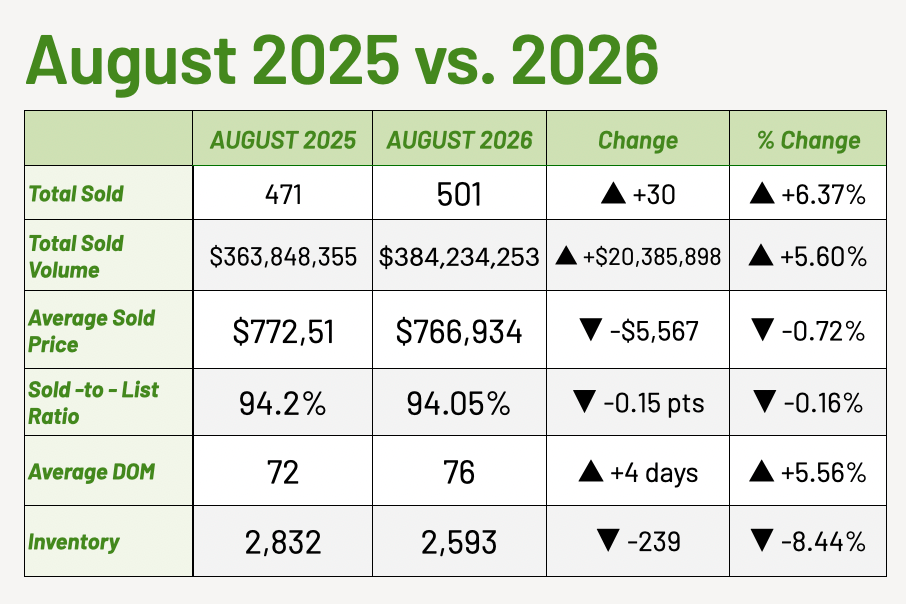
What stands out most?
- Sales activity improved. Thirty more homes sold this August than last August, representing a 6.37% increase in transactions.
- Dollar volume increased 5.60%. Greater Palm Springs generated approximately $384.2 million in residential sales volume, up more than $20 million year over year.
- Average pricing barely moved. Despite changing market conditions, the average sold price declined just 0.72% year over year.
- Inventory is lower, but homes aren't selling faster. There are 8.44% fewer homes available than last August, yet average market time increased to 76 days. This tells us buyers remain selective even with fewer choices.
That last point is particularly important.
In a traditional seller's market, declining inventory would typically be accompanied by faster sales and stronger pricing power.
We're not seeing that consistently today.
Instead, the August numbers suggest a more balanced and selective environment in which neither buyers nor sellers have complete control.
Real Estate Is Local: August Results Across the Desert Cities
The valley-wide averages are useful, but Greater Palm Springs is not one single housing market.
August average sold prices ranged from approximately $415,777 in Desert Hot Springs to $1,350,125 in Indian Wells.
Several of the area's major markets recorded:
This is why we encourage buyers and sellers to look beyond a single valley-wide statistic.
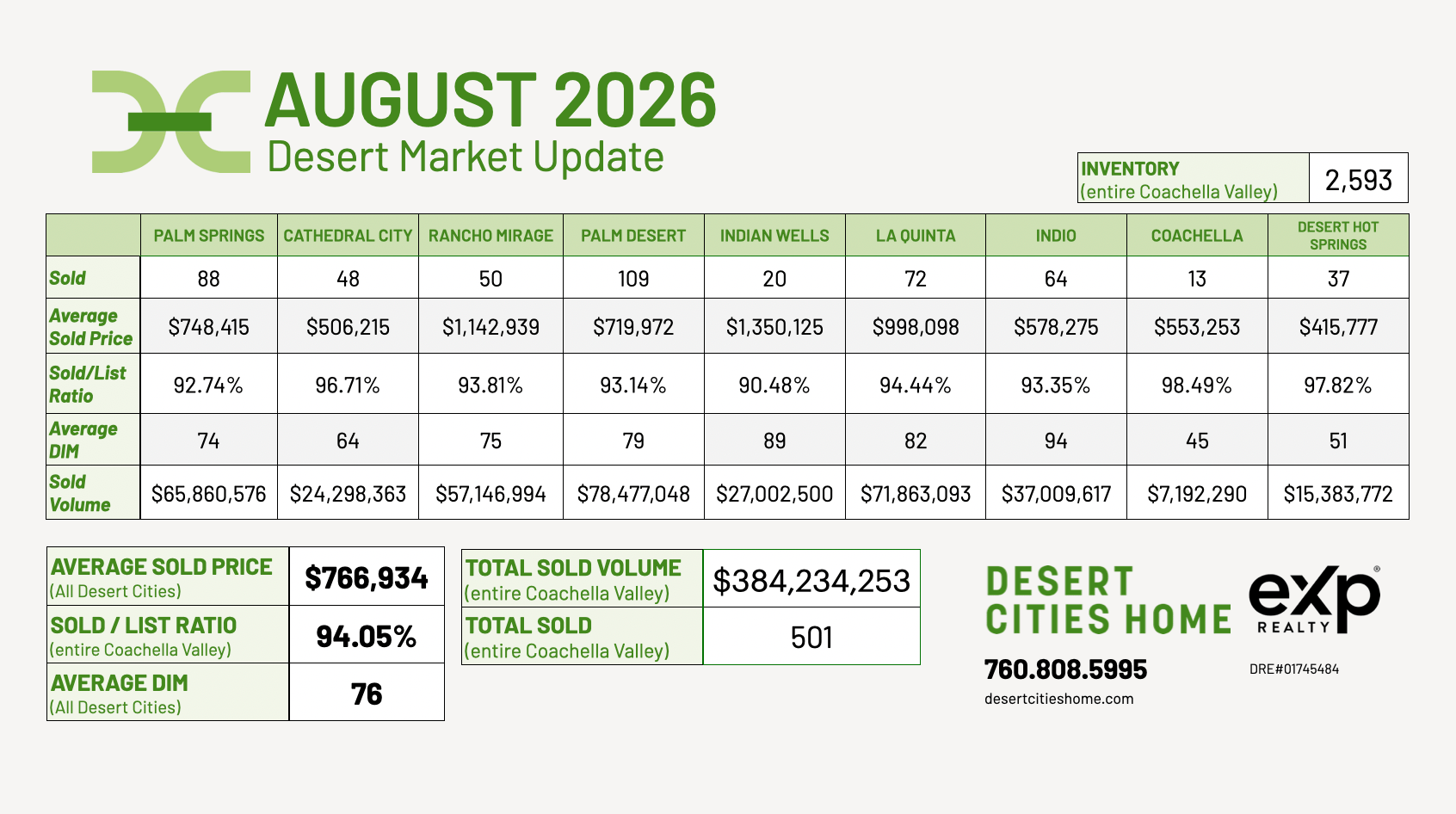
The market for a luxury home in Indian Wells or Rancho Mirage can behave very differently from a condominium in Palm Springs, a golf-course home in Palm Desert, or a newer property in Indio.
Price point, property type, community, condition, land ownership, HOA restrictions and even the specific neighborhood can materially change the market dynamics.
What September's Market Could Mean for Buyers
September is the final month of low season, and that can create an interesting opportunity for buyers.
Homes are taking an average of 76 days to sell, and the valley-wide sold-to-list ratio is approximately 94%.
That means buyers may find opportunities to negotiate on price, repairs, closing costs or other transaction terms, particularly when a property has been listed for an extended period.
But there's another side to the equation.
Inventory has fallen to 2,593 homes and is 8.44% lower than it was one year ago.
Waiting for prices to fall doesn't necessarily guarantee that the right property will still be available when seasonal demand begins returning.
For buyers, September may offer an attractive combination of summer negotiating leverage before fall buyer traffic begins rebuilding.
What September's Market Could Mean for Sellers
Sellers should take encouragement from the fact that 501 homes closed during August, even during low season.
There are buyers in the market.
The challenge is getting their attention.
With homes averaging 76 days on market and selling below asking price on average, pricing a property based on where the market is today—not where it was several years ago or what a neighbor hopes their home is worth—is increasingly important.
For homeowners considering selling this fall, September can also serve as a valuable preparation period.
This is the time to address repairs, improve curb appeal, prepare photography and marketing, evaluate competing listings and establish a pricing strategy before the desert moves into shoulder season in October.
What Does the August 2026 Market Tell Us?
August wasn't a dramatic month—and that's actually one of the more interesting conclusions.
Compared with August 2025:
More homes sold. More dollars changed hands. Average prices remained relatively stable. Inventory declined. But buyers continued negotiating and homes took slightly longer to sell.
That's not the profile of a collapsing market.
It's also not the profile of an overheated seller's market.
Instead, Greater Palm Springs appears to be operating in a selective, price-sensitive environment where strategy matters on both sides of the transaction.
For buyers, there are opportunities to negotiate.
For sellers, there are still buyers willing to act.
And for both sides, understanding the difference between the overall Coachella Valley market and the specific city, neighborhood, price range and property type is becoming increasingly important.
As we move through September and toward the beginning of shoulder season in October, we'll be watching inventory, days on market, sales activity and the sold-to-list ratio particularly closely.
Those numbers should give us our first indication of how the Greater Palm Springs housing market is positioned heading into the 2026–2027 seasonal real estate cycle.